
Fiber Tethered Drone Connectivity Solutions
Designed and manufactured in Irvine,
California
What is fiber tethered drone connectivity?
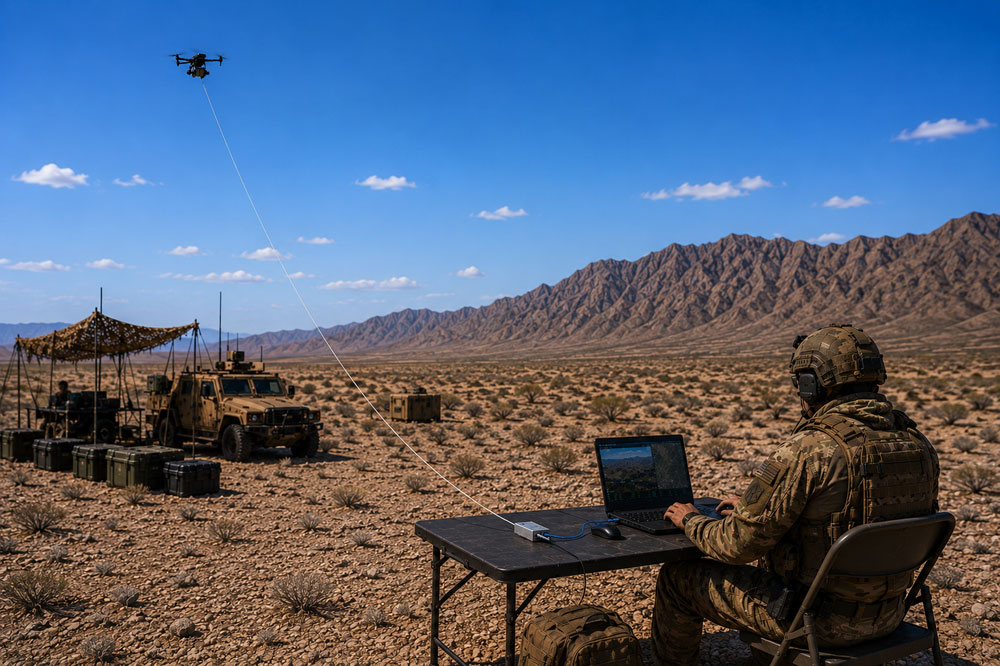
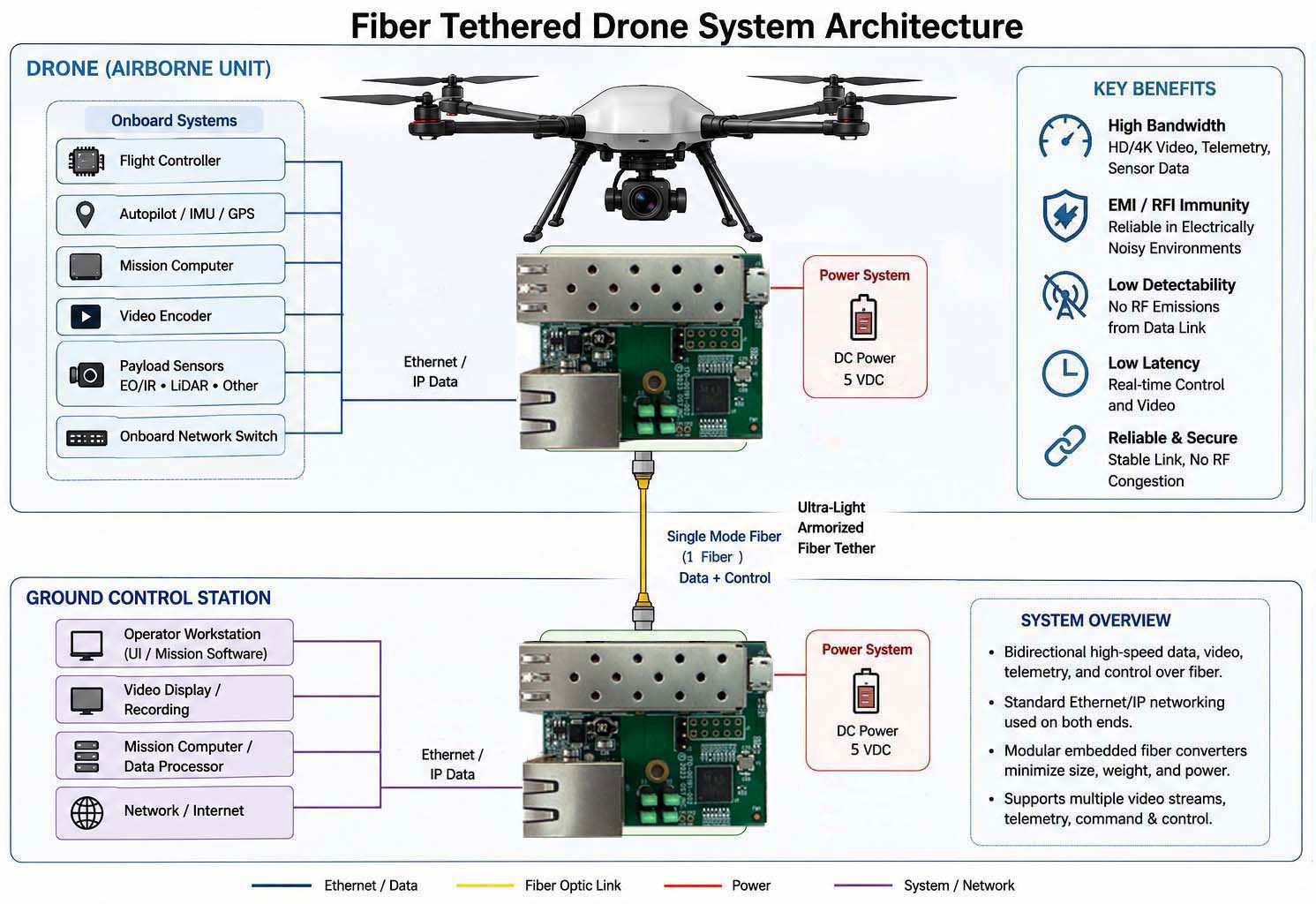
Fiber tethered drone connectivity uses an optical fiber link to carry Ethernet data between an airborne unmanned aerial vehicle and a ground-side network. Onboard cameras, sensors or computers connect to an air-side media converter. The converter changes the electrical Ethernet signal into an optical signal for transmission through the fiber tether. A compatible ground-side converter then provides the network handoff to a switch, video recorder, workstation or command system.
Because the optical path carries light rather than electrical or radio-frequency signals, it is immune to EMI and RFI along the fiber. It also does not require RF spectrum for the fiber data path. Depending on the interfaces, converter models and network design selected, the connection can transport video, sensor, telemetry and control traffic.
Omnitron supplies the copper-to-fiber and fiber-to-copper network conversion components. The UAV platform, flight-control system, aircraft power system and mechanical tether remain separate parts of the complete solution unless they are supplied by an integration partner.
How the Air-to-Ground Fiber Link Works




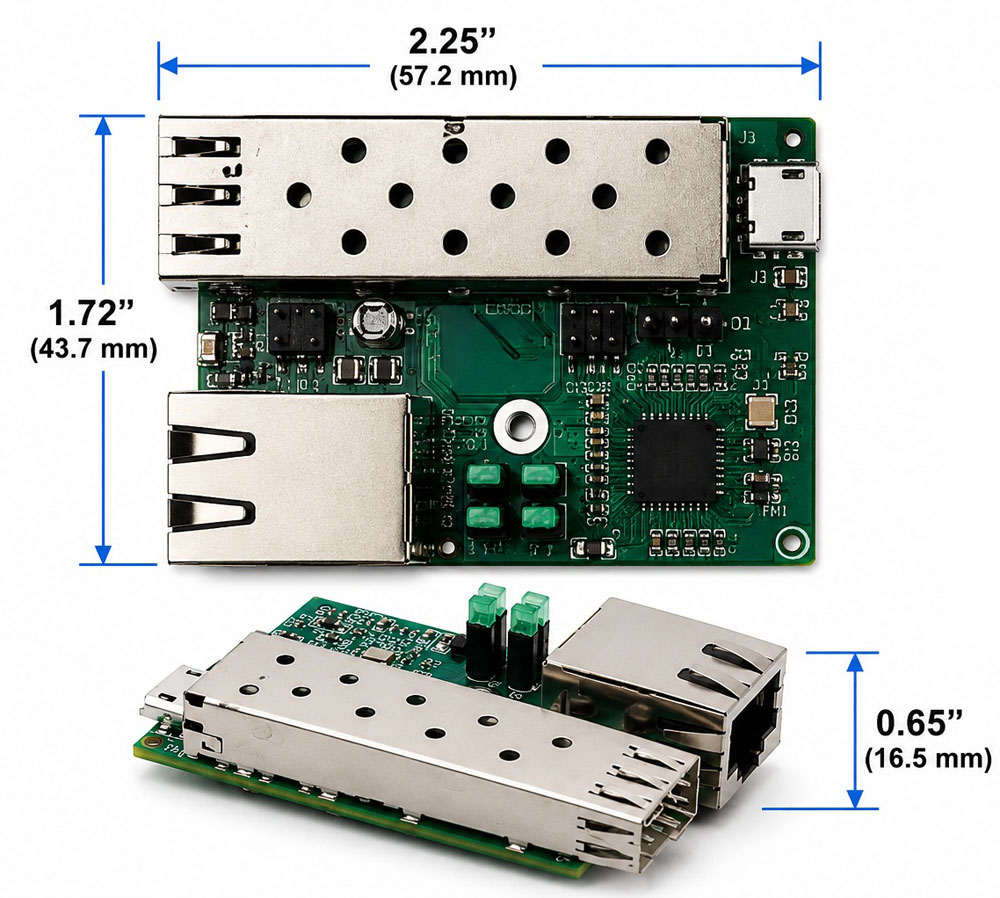
Compact air-side fiber connectivity with the miConverter S-Series
Air-Side Connectivity Capabilities
- Copper-to-fiber Ethernet media conversion
- Fast Ethernet and Gigabit platform options
- Fixed-fiber and SFP-based models
- Multimode, single-mode and single-fiber options by model
- Compact, low-power architecture
- Commercial and wide-temperature configurations by model
- Optional conformal coating on applicable configurations
- Made in the USA with procurement-compliant options
Talk to Omnitron Networking Experts
Email: info@omnitron-systems.com
Why Use Fiber for Tethered Drone Communications?
EMI and RFI Immunity

The fiber data path is not affected by electromagnetic or radio-frequency interference, supporting operation around electrically noisy equipment and congested RF environments.
Consistent Wired Connectivity

A physical optical path (multimode or single-mode fiber) provides a predictable connection between the airborne platform and ground-side network.
Compact Air-Side Integration
A board-level media converter helps system integrators reduce the space and enclosure overhead associated with conventional standalone network hardware.
Flexible Network Handoff

Connect the fiber tether to Ethernet switches, recorders, monitoring platforms or control networks through the selected ground-side converter.
Built for Demanding Applications
Persistent Surveillance
Maintain a defined optical data path for continuous video, sensor and telemetry traffic over a controlled operating area.
Border and Perimeter Monitoring
Connect elevated cameras and sensors used to observe secured facilities, borders and property perimeters where dependable network access is required.
Emergency Response
Support temporary elevated observation or communication systems when terrestrial infrastructure is damaged, unavailable or congested.
Critical Infrastructure Inspection
Transmit data from airborne cameras and sensors monitoring utilities, transportation systems, pipelines, industrial sites and other difficult-to-access assets.
Public Safety and Event Monitoring
Provide persistent aerial visibility for emergency management, traffic operations, crowd monitoring and large-area public-safety applications.
Government and Defense Integration
Use U.S.-made network connectivity components in procurement-sensitive platforms developed by government contractors, agencies and system integrators.


U.S.-Made Connectivity for Government Procurement
Omnitron designs and manufactures network connectivity products in Irvine, California. Since 1992, the company has developed fiber networking equipment for government, defense, transportation, utility, industrial and critical infrastructure deployments.
System integrators choose Omnitron when product origin, supply-chain visibility, engineering support and long-term product availability are important to the project.

24/7
Support

TAA, BAA and NDAA
Compliance

Made in
USA

Temperature
Hardened
Tell Us About Your Requirements
Whether you are developing a new tethered UAV or adding fiber connectivity to an existing platform, Omnitron can help evaluate the air-side media converter, optical interface and ground-network handoff required for your application.
To help Omnitron recommend the appropriate configuration, provide as much of the following information as possible:
- Required Ethernet data rate
- Air-side copper Ethernet interface
- Multimode or single-mode fiber
- Single-fiber or dual-fiber architecture
- Required link distance Preferred fiber connector
- Available air-side input power
- Board or enclosure size and weight limits
- Operating-temperature range
- Vibration, altitude and environmental conditions
- Conformal-coating requirement
- Ground-station network interface
- TAA, BAA or NDAA procurement requirements
Submit Your Application Requirements
Frequently Asked Questions
What is a fiber tethered drone?
A fiber tethered drone is an unmanned aerial vehicle that uses an optical fiber tether to exchange data with ground equipment. Depending on the system design, the connection can carry video, sensor, telemetry and control traffic. The tether limits the aircraft’s mobility but provides an optical data path that is immune to EMI and RFI along the fiber.
How does a fiber tethered drone communicate with a ground station?
Onboard equipment connects to an air-side media converter through Ethernet. The converter changes the electrical Ethernet signal into an optical signal that travels through the fiber tether. A compatible converter at the ground station changes the optical signal back to Ethernet for a switch, recorder, server or workstation. Traffic can move in both directions when the selected equipment and network architecture support bidirectional communication.Does the fiber tether also provide power to the drone?
Not by itself. A standard communications fiber carries data, not conventional electrical power. Some UAV systems use a hybrid tether with separate electrical conductors, while specialized systems may use power-over-fiber technology. Omnitron’s role in this solution is network media conversion. The UAV and tether integrator must design and validate the aircraft’s power-delivery system.
Which Omnitron media converter can be used on the air side?
The correct model depends on the required Ethernet rate, fiber interface, power source, physical limitations and operating environment. Omnitron’s compact miConverter S-Series includes Fast Ethernet and Gigabit options. Any board-level air-side configuration and its exact specifications must be confirmed by Omnitron engineering before integration.
Can Omnitron support both the air side and ground side of the link?
Omnitron can help select media-conversion components for both ends of the optical data link. The selected products must match in data rate, fiber type, wavelength, connector, distance and operating environment. The ground-side converter can provide an Ethernet handoff to a compatible switch, video recorder, server, workstation or command network.
What fiber types and connectors can Omnitron support?
Depending on the selected converter, Omnitron supports multimode fiber, single-mode fiber and single-fiber bidirectional configurations. Available interfaces can include fixed SC or ST connectors and flexible SFP-based options. The final selection depends on bandwidth, tether length, fiber count, connector limitations and environmental requirements.
Can a fiber tethered drone link operate in a high-EMI environment?
Yes. The optical path is immune to electromagnetic and radio-frequency interference because it transmits information as light rather than as an electrical or wireless signal. The supporting converters, power equipment, connectors, enclosures and other system components must still be evaluated for electrical exposure, temperature, vibration, moisture and mechanical conditions.
Is a fiber tethered data link more secure than an RF link?
A fiber tether avoids transmitting the data path through open RF spectrum and generally requires access to the tether or one of its endpoints to intercept the optical link. However, overall system security still depends on endpoint protection, authentication, encryption, physical security and network design. A fiber tethered connection should not be described as unhackable or inherently secure.
Are Omnitron drone-connectivity components TAA, BAA and NDAA compliant?
Omnitron states that its products are TAA, BAA and NDAA compliant, except for SFP transceivers and CWDM multiplexers, which are TAA and NDAA compliant only. Compliance should be verified for every component in the proposed configuration before procurement. Review Omnitron’s TAA, BAA and NDAA compliance information.
What information does Omnitron need to recommend a configuration?
Provide the required Ethernet data rate, fiber type, tether length, fiber count, connector preference, air-side power input, physical size and weight limits, operating-temperature range, environmental conditions, ground-network interface and procurement requirements. These details help Omnitron determine whether an existing media converter or an engineering-reviewed integration configuration is the better fit.

Resource Center

Free Network Design


