

AI Infrastructure Connectivity for On-Premise Data Center

Introduction
As demand grows for non-cloud connected data centers to support sensitive workloads, hyperscaler operators are now deploying AI infrastructure at customer locations and private data centers, with the need for fiber and copper connectivity and conversion.
The Challenge
A leading hyperscale data center provider was approached by customers seeking private, on-premises AI infrastructure. These organizations required high-performance AI processing environments that could operate entirely within their own facilities, without reliance on cloud connectivity.
The primary drivers behind this shift included data security, regulatory compliance, and latency-sensitive applications. By keeping AI workloads local, customers ensured that sensitive data never left the premises while enabling real-time processing for mission-critical operations.
However, designing these private AI environments introduced a significant infrastructure challenge.
The data center network enforced a strict fiber-only policy for inter-rack connectivity, eliminating copper Ethernet cabling between racks to improve performance, reduce interference, and align with modern data center architecture standards. Within these environments, a critical design constraint emerges:
1. No copper Ethernet cabling is permitted between racks.
Most of the AI processing devices have RJ-45 copper ports only, including:
-
- AI compute servers
- Power Distribution Units (PDUs)
- Console servers
2. Existing 1Gb RJ45 copper management interfaces. This creates a gap between:
-
-
- Copper-based device interfaces
- Fiber-based inter-rack connectivity requirements
-
3. Additional challenges include:
-
-
- Supporting up to 37 copper-to-fiber conversion per chassis
- Maintaining signal integrity across rack-to-rack distances
- Ensuring centralized visibility and control across distributed racks
- Designing for scalable deployments (multiple AI and management racks)
- Avoiding unmanaged point solutions that increase operational complexity
-
In short, network architects had to bridge copper-based management interfaces into a fiber-only interconnect architecture, without sacrificing manageability or scalability.
The Solution
To support this architecture, the managed iConverter® chassis-based media converter was chosen to performing high-density copper-to-fiber conversion with centralized network management and scalability.
At the AI Server Rack (Top-of-Rack Integration)
Each AI server rack integrates:
- A managed iConverter chassis populated with copper-to-fiber media converter modules
- AI server management ports
- Dual PDUs
- Console server
Two deployment scenarios are supported:
Option 1: Fiber-Enabled Management Switch
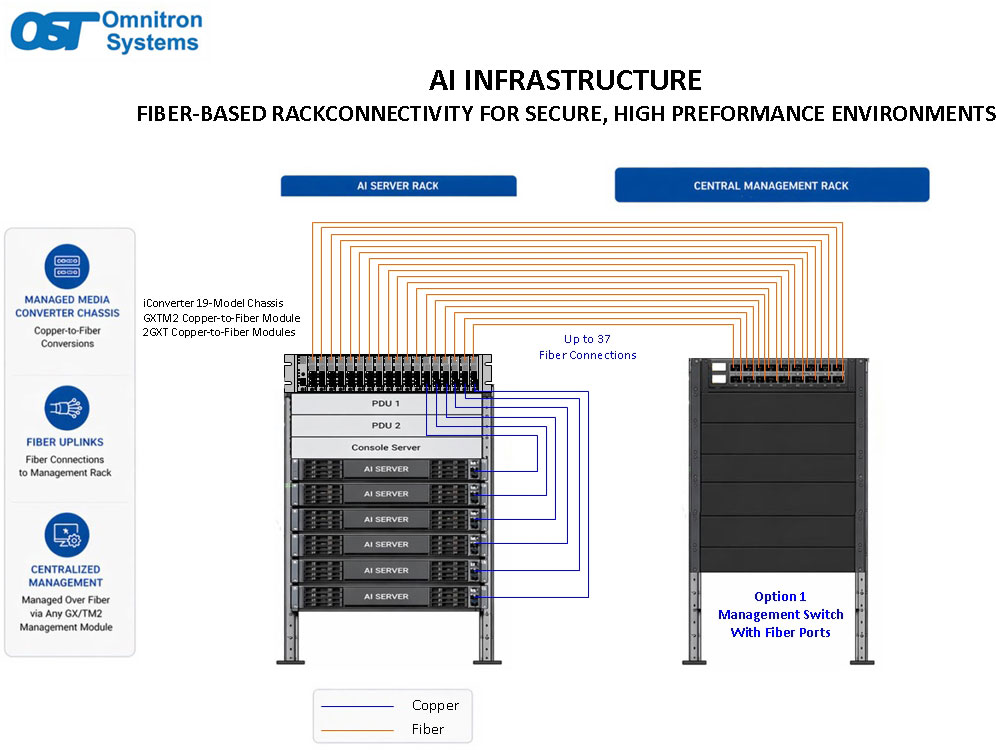
If the management switch includes native fiber (SFP) ports:
-
- Fiber links from AI racks connect directly into the switch
- No additional conversion required
Benefits:
-
- Simplified architecture
- Reduced hardware footprint
- Lower latency and fewer failure points
Option 2: Copper-Based Management Switch
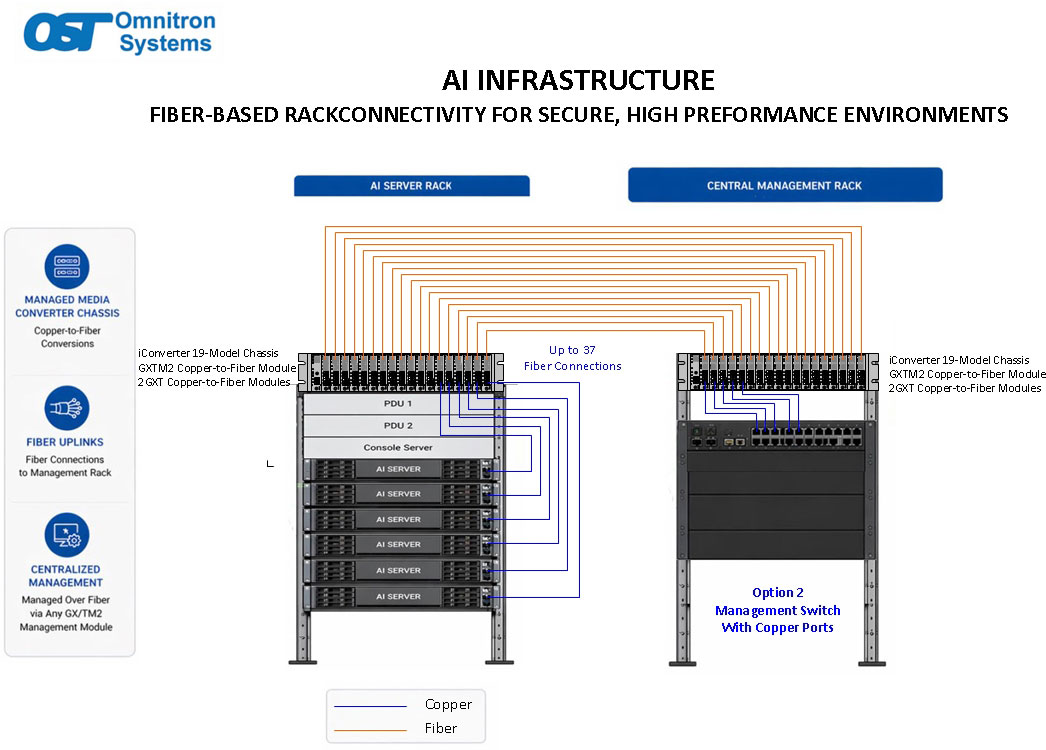
If the management switch only supports RJ45 copper:
-
- A second iConverter chassis is deployed in the management rack
- iConverter 2GXT media converters are used in order to save on rack space, with 2 copper and 2 fiber ports on each converter
- Fiber connections are converted back to copper
- Copper links connect into the management switch
Benefits:
- Enables reuse of existing switching infrastructure
- Provides flexibility in mixed environments
- Maintains full fiber transport between racks
Omnitron’s iConverter solution enables:
-
- Up to 37 copper-to-fiber conversions per rack
- Clean aggregation of all management traffic into fiber uplinks
- Elimination of copper cabling between racks
A dedicated iConverter GX/TM2 management module provides:
-
- In-band management over fiber
- Centralized monitoring of all installed modules
Fiber Transport Between Racks
-
- Each AI rack transmits management traffic over multiple fiber links (e.g., 8 fibers)
- Fiber runs connect directly to a centralized management rack
- This design ensures:
- EMI immunity
- Long-distance reliability
- Compliance with fiber-only interconnect policies
At the Central Management Rack
Scalability & Architecture
-
- Each chassis supports high-density modular configurations (e.g., 19 modules)
- Fully managed platform enables:
- Remote configuration
- Fault monitoring
- Link status visibility
Key Benefits
-
- Fiber-Only Inter-Rack Design
Maintains strict compliance with fiber infrastructure standards while supporting legacy copper interfaces. Fiber is chosen for multiple reasons – Security (harder to tap fiber than copper cables), EMI immunity and electrical isolation, distance between racks and for future-proofing as bandwidth needs increase.
- Fiber-Only Inter-Rack Design
-
- High-Density Conversion at the Edge
Up to 37 device connections per rack without adding switch complexity, and room for growth with more slots that can be populated with more managed media converters.
- High-Density Conversion at the Edge
-
- Centralized Management
Full visibility and control of distributed media converters via managed chassis modules.
- Centralized Management
-
- Flexible Integration
supports both fiber-native and copper-based management switching environments.
- Flexible Integration
-
- Scalable Architecture
Easily expands to support additional racks and AI workloads without redesign.
- Scalable Architecture
-
- Improved Reliability
Fiber eliminates EMI concerns and improves signal integrity across racks and distances.
- Improved Reliability
Cost and Operational Complexity
A chassis of media converter modules centralizes copper‑to‑fiber conversion; installation is straightforward (power up the chassis, plug in copper and fiber cables), and 10/100/1000‑Mbps media converters are generally the most cost‑effective way to extend fiber. Because each chassis can handle up to 37 fiber ports, a 2U chassis replaces numerous NIC or switch upgrades, reducing space in the rack, capital expenditure and operational complexity. The managed media converter chassis strikes a great balance between cost and simplicity.
The Result
This solution enables the hyperscale data center to provide a solution that met all customer requirements:
-
- Localized compute and storage
- Fiber-based rack interconnects
- Seamless integration of copper-based management interfaces
- Centralized, scalable network management
The result was a future-ready architecture that aligns with hyperscaler design principles while meeting the strict requirements of high-security, disconnected environments.
Why Omnitron Systems
Omnitron was selected for several critical reasons:
-
- Proven Reliability
iConverter products are designed for mission-critical applications where downtime is not an option. - Pre- and Post-Sales Technical Support
Omnitron provided hands-on design assistance, ensuring the solution was optimized for both performance and scalability. - Lifetime Warranty on all iConverter Media Converters
Omnitron media converters come with a lifetime warranty and 7/24 Technical Support - Made in the USA
Fully compliant with TAA, BAA, and NDAA requirements, ensuring safe and secure networks
- Proven Reliability
Product Overview
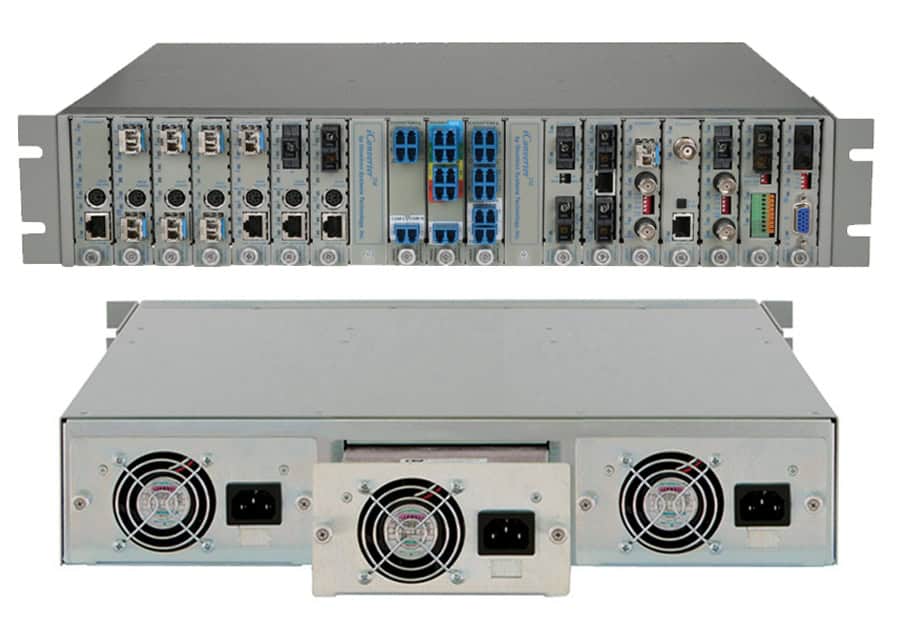
iConverter 19-Module Chassis
Managed Redundant-Power Chassis
The iConverter 19-Module Chassis is designed for Enterprise Local Area Network (LAN) and Data Center applications where fault tolerance and high-density rack footprint are essential. The 2U (3.5 inch) high iConverter 19-Module Chassis supports up to three power supplies for redundancy, and can be mounted in a 19-inch or 23-inch rack.
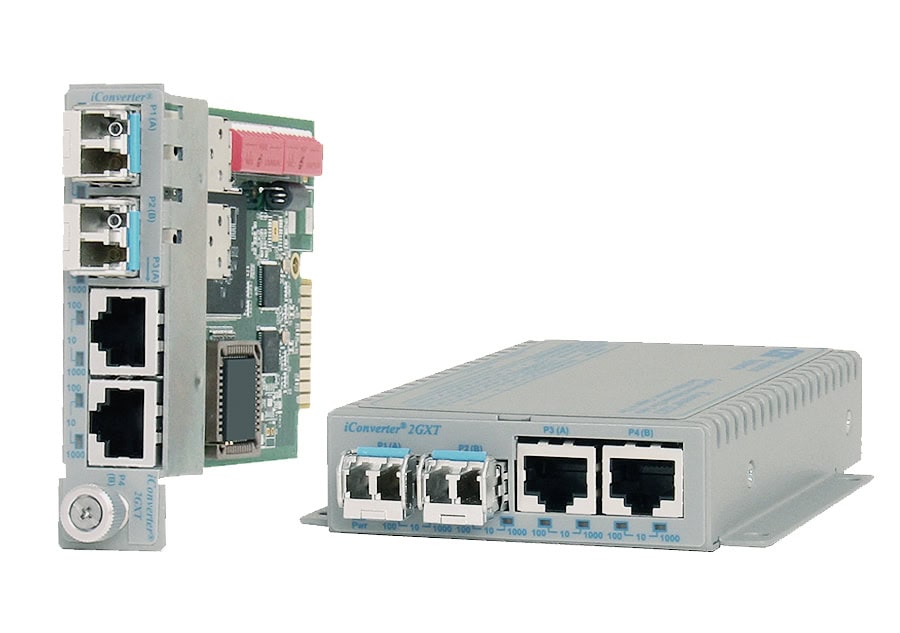
iConverter 2GXT
10/100/1000BASE-T to 100/1000BASE-X 2-Channel Ethernet Media Converter
iConverter 2GXT is a dual-channel media converter and four-port switch with two 10/100/1000BASE-T RJ-45 ports and two Small Form Pluggable (SFP) ports. The dual SFP fiber ports can be configured to provide 1:1 uplink protection with less than 50ms switchover when the 2GXT is deployed as a four-port switch.
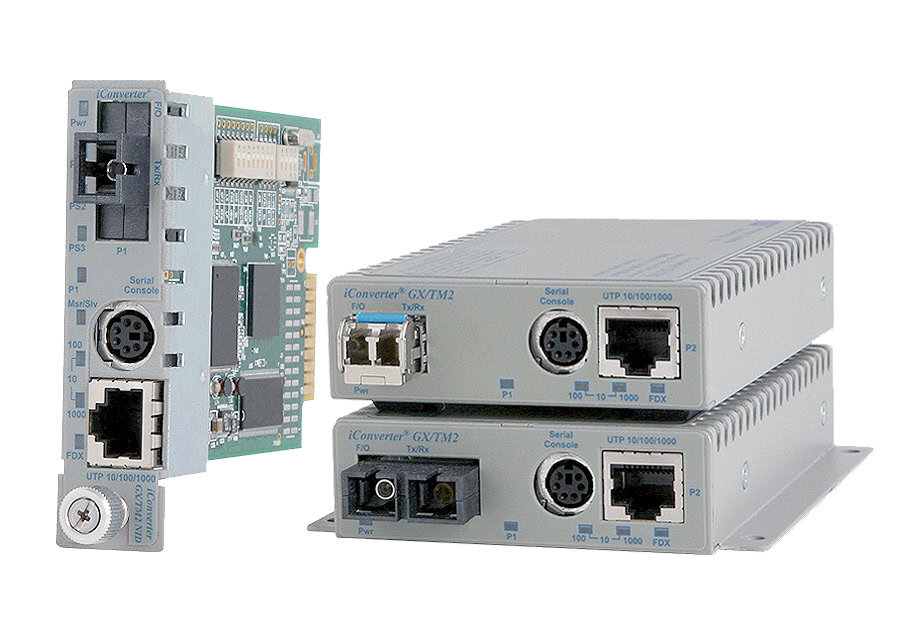
iConverter GX/TM2
10/100/1000 Copper to Gigabit Fiber Media Converter and Network Interface Device
The iConverter GX/TM2 is a carrier-grade Network Interface Device (NID) that provides 10/100/1000 copper to Gigabit Ethernet fiber media conversion with integrated management. The GXTM2 models are available with ST, SC and LC fixed-fiber connectors and the RJ-45 port supports 10/100/1000 and Half/Full-Duplex auto-negotiation and Pause control, with both hardware and software manual override controls.
