AI Data Center Connectivity: How Secure Fiber Infrastructure Is Powering Modern AI Data Centers
2514 Visits
AI Data Center Connectivity is becoming one of the most critical components of modern enterprise infrastructure as organizations rapidly deploy private AI environments inside secure, high-performance data centers.
From hyperscale operators to government facilities, businesses are increasingly investing in fiber-based AI networking architectures that deliver scalability, low latency, centralized visibility, and stronger data protection for mission-critical workloads.
As artificial intelligence adoption accelerates across industries such as healthcare, finance, defense, manufacturing, and critical infrastructure, enterprises are shifting away from fully public cloud dependency and building localized AI infrastructure environments that provide complete operational control.
This article explores how Omnitron Systems enabled a leading hyperscale operator to deploy scalable and secure AI Data Center Connectivity using the company’s modular iConverter® managed media conversion platform.
Why Is AI Data Center Connectivity Becoming Essential for Enterprises?
Artificial intelligence infrastructure demands far more than raw compute power. Modern AI workloads require:
High-bandwidth networking
Ultra-low latency communication
Secure inter-rack connectivity
Centralized infrastructure visibility
Scalable fiber network architecture
Reliable remote management
Long-distance signal integrity
Many organizations now require AI systems to operate entirely within isolated and secure environments instead of relying on public cloud providers.
What Industries Require Private AI Infrastructure?
As artificial intelligence becomes deeply integrated into enterprise operations, organizations across multiple industries are rapidly shifting toward private AI environments hosted inside secure and localized data centers. Instead of relying entirely on public cloud providers, businesses are building dedicated AI infrastructure designed to provide greater control over security, compliance, latency, and operational continuity.
This transition is significantly increasing demand for advanced AI Data Center Connectivity solutions capable of supporting high-performance computing environments with scalable fiber networking, centralized infrastructure management, secure inter-rack communication, and long-term reliability.
Industries adopting private AI infrastructure are not simply investing in faster computing power. They are redesigning entire network architectures to support mission-critical AI workloads that require continuous uptime, protected data environments, and secure communications across distributed systems.
Healthcare Organizations Handling Sensitive Patient Data
Healthcare organizations are among the fastest-growing adopters of private AI infrastructure due to the enormous amount of highly sensitive patient information processed within modern medical systems.
Hospitals, research institutions, diagnostic laboratories, and healthcare networks now use artificial intelligence for a wide range of operational and clinical applications, including medical imaging analysis, patient diagnostics, predictive healthcare modeling, treatment recommendations, electronic health record processing, and real-time patient monitoring.
These AI systems frequently process confidential medical records and protected healthcare information that must remain compliant with strict regulatory frameworks such as HIPAA and other healthcare privacy standards.
For many healthcare providers, relying entirely on public cloud infrastructure introduces concerns related to:
Third-party data exposure
Compliance risks
Data sovereignty
Latency during real-time diagnostics
Infrastructure availability during emergencies
As a result, healthcare organizations increasingly deploy AI compute environments inside private data centers where they maintain complete ownership of infrastructure and security policies.
Reliable AI Data Center Connectivity is essential in these environments because AI-driven healthcare systems require uninterrupted communications between computer clusters, storage platforms, monitoring systems, and centralized management infrastructure. Fiber-based connectivity also helps healthcare facilities improve network reliability, reduce electromagnetic interference, and support secure long-distance communications across distributed hospital environments.
How Are Financial Institutions Using Private AI Infrastructure?
Financial institutions are undergoing one of the most significant technological transformations in modern business infrastructure. As artificial intelligence becomes deeply integrated into banking operations, investment analysis, digital payments, cybersecurity, and customer engagement systems, financial organizations are increasingly building private AI environments inside secure enterprise data centers instead of relying entirely on public cloud infrastructure.
This shift is being driven by the growing need for stronger data protection, faster processing speeds, lower latency communications, regulatory compliance, and uninterrupted operational continuity. Modern banks and financial service providers operate in environments where milliseconds matter, system downtime can result in massive financial losses, and data exposure risks can impact both customer trust and legal compliance.
As a result, private AI infrastructure is becoming a foundational component of next-generation financial technology architecture, and scalable AI Data Center Connectivity is playing a critical role in supporting these advanced environments.
Why Are Banks Investing in Private AI Infrastructure?
Banks are increasingly using artificial intelligence to automate operations, improve customer experiences, strengthen cybersecurity defenses, and optimize financial decision-making processes.
Modern banking systems process enormous amounts of real-time information every second. From digital transactions and mobile banking requests to fraud monitoring and automated loan approvals, AI systems now influence almost every aspect of financial operations.
Many banks prefer private AI infrastructure because it allows them to maintain complete ownership and control over highly sensitive operational systems while reducing dependence on external cloud providers.
Private AI environments also help banks improve infrastructure consistency, operational visibility, and security governance across distributed financial networks.
In highly regulated financial industries, maintaining internal control over AI workloads has become increasingly important for compliance, auditing, and long-term operational resilience.
How Is Artificial Intelligence Transforming Financial Services?
Artificial intelligence is now deeply embedded within the financial services industry. AI systems are being used to analyze massive datasets, identify suspicious activity, automate repetitive workflows, and deliver faster decision-making capabilities.
Financial organizations use AI technologies for:
Fraud Detection and Prevention
One of the most critical applications of AI in finance is real-time fraud detection. Artificial intelligence systems continuously monitor transactions, customer behavior patterns, account activity, and payment flows to identify suspicious activity before financial damage occurs.
These systems analyze enormous volumes of transaction data within milliseconds, making low-latency infrastructure essential for maintaining accurate and responsive fraud prevention capabilities.
Private AI infrastructure enables banks to process this sensitive information internally while minimizing exposure to external systems.
Automated Trading and Investment Analysis
Investment firms and trading organizations increasingly rely on AI-powered analytics to monitor market behavior, predict trends, and automate trading decisions.
These systems often process live financial market data in real time, requiring ultra-fast networking infrastructure capable of supporting continuous communications between trading platforms, AI compute clusters, and data processing systems.
In these environments, even minor delays can impact transaction timing, market responsiveness, and investment performance.
Private AI environments help financial organizations reduce latency while maintaining direct control over critical trading infrastructure.
Customer Analytics and Personalized Banking
Artificial intelligence is also transforming customer experience strategies within financial institutions. Banks now use AI to analyze customer behavior, spending habits, financial goals, and service preferences to provide more personalized financial recommendations and support.
These AI-driven systems improve customer engagement while helping institutions deliver smarter financial products and more efficient digital banking experiences.
Because these platforms process sensitive customer identity information and financial records, organizations increasingly prefer private AI infrastructure environments that offer stronger internal data protection.
Cybersecurity and Threat Intelligence
Cybersecurity has become one of the most important priorities for financial institutions worldwide. AI-driven security systems continuously monitor networks, identify abnormal behavior, analyze potential threats, and automate defensive responses.
Private AI infrastructure allows cybersecurity systems to operate within isolated environments where organizations maintain direct control over network visibility, monitoring policies, and incident response procedures.
Secure AI Data Center Connectivity architectures are essential in these environments because AI-driven cybersecurity platforms depend on continuous high-speed communication between monitoring systems, analytics engines, and centralized security management infrastructure.
Why Do Hyperscale AI Data Centers Prefer Fiber-Only Infrastructure?
Fiber networking has become the preferred architecture for modern AI data centers because it offers major operational and security advantages.
How Does Fiber Improve AI Data Center Performance?
Fiber-based AI Data Center Connectivity improves infrastructure performance through:
Better EMI Immunity
Fiber eliminates electromagnetic interference commonly found in high-density environments.
Longer Distance Reliability
Fiber supports stable communication across distributed AI rack environments without signal degradation.
Higher Bandwidth Scalability
AI workloads continuously increase networking demands, making fiber essential for future scalability.
Enhanced Security
Fiber is significantly more difficult to intercept or tap compared to traditional copper Ethernet.
Improved Signal Integrity
Fiber maintains cleaner and more stable communications across hyperscale infrastructure deployments.
What Technical Challenges Did the Engineering Team Face?
The deployment required solving several critical networking and operational challenges.
1. How Do You Scale Copper-to-Fiber Conversion in AI Data Centers?
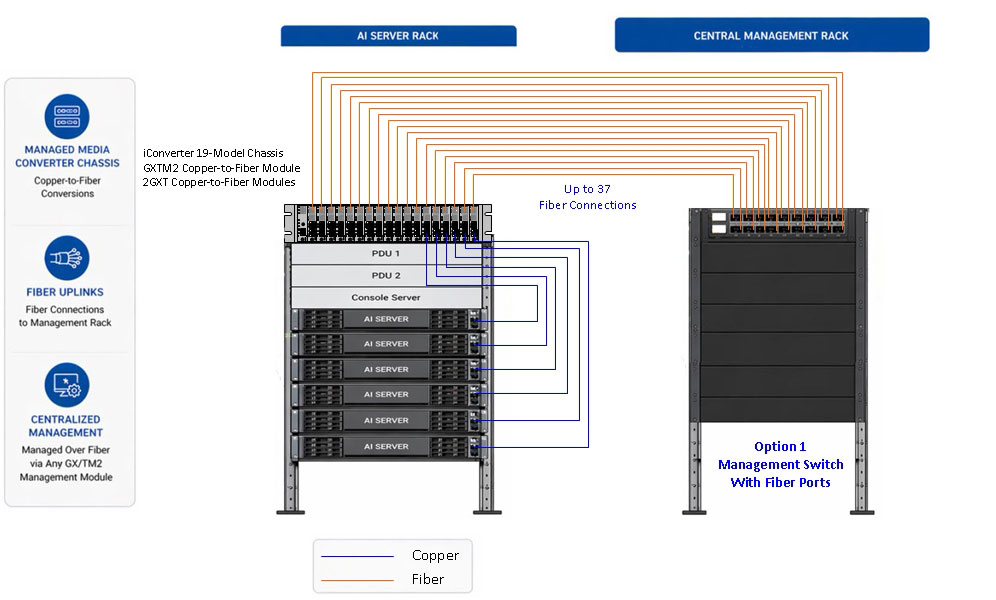
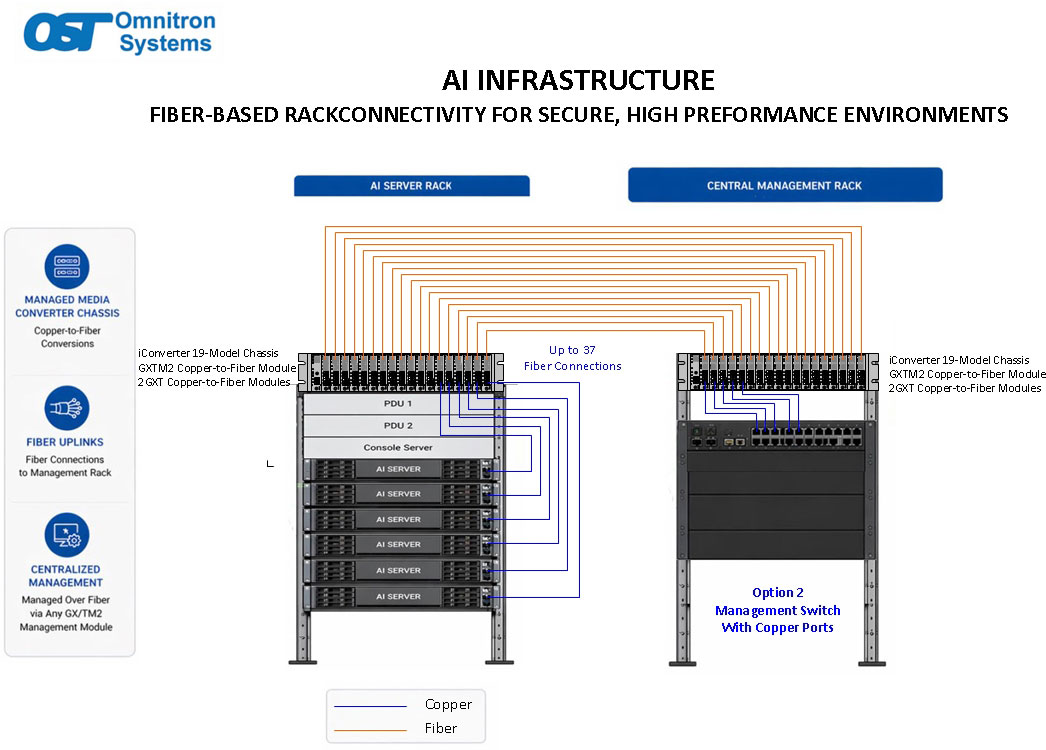
Each AI rack required support for up to 37 copper-to-fiber conversions while minimizing rack footprint and operational complexity.
This required:
High-density media conversion
Centralized management
Modular scalability
Reliable fiber aggregation
Simplified maintenance
2. How Was Signal Integrity Maintained Across Distributed AI Racks?
The solution needed to maintain stable performance across multiple distributed rack environments while supporting long-distance fiber transport.
Why Was Centralized Visibility Important?
The hyperscale operator required centralized visibility into:
Link status
Module health
Connectivity faults
Power conditions
Infrastructure alerts
Without centralized management, troubleshooting large-scale AI environments becomes operationally inefficient.
3. How Did the Architecture Support Future AI Expansion?
The infrastructure needed to scale without requiring disruptive redesigns or expensive hardware replacement projects.
Scalability was one of the most important requirements of the entire AI Data Center Connectivity deployment.
How did the Hyperscaler connect and manage the AI Server racks?
To address these infrastructure challenges, the hyperscale operator selected the iConverter® 19-Module Managed Chassis platform from Omnitron Systems.
The deployment provided:
High-density copper-to-fiber conversion
Centralized infrastructure management
Fiber-only inter-rack communication
Remote monitoring capabilities
Enterprise-grade scalability
AI-ready modular architecture
How Did the AI Rack Architecture Work?
Inside each AI server rack, the infrastructure integrated:
Managed iConverter chassis
Copper-to-fiber media converter modules
AI compute management ports
PDUs
Console servers
This architecture aggregated management traffic into centralized fiber uplinks while completely eliminating copper cabling between racks.
The result was a highly scalable AI Data Center Connectivity environment optimized for secure and modern hyperscale operations.
What Benefits Did the Managed iConverter Platform Deliver?
The managed iConverter platform delivered scalable, secure, and centralized fiber networking for AI infrastructure environments. It improved network visibility, simplified management, supported modular expansion, reduced infrastructure costs, enabled seamless copper-to-fiber integration, and enhanced long-term reliability. Its high-density architecture and redundant power design ensured flexibility, uptime, and future-ready scalability for hyperscale deployments.
How Did the Platform Improve High-Density Connectivity?
The solution supported up to 37 copper-to-fiber conversions per rack while reducing operational complexity and preserving valuable rack space.
How Did Fiber Aggregation Simplify Infrastructure?
All management traffic was consolidated into fiber uplinks, simplifying inter-rack communications and reducing infrastructure sprawl.
This dramatically improved operational visibility across the distributed AI environment.
What Are the Two Central Management Rack Design Options?
The deployment supported two architecture models depending on the customer’s existing switching infrastructure.
How Does Native Fiber Switching Improve AI Data Center Connectivity?
Option 1: Fiber-Enabled Management Switch
When the management switch included native SFP fiber ports, fiber uplinks from AI racks connected directly into the management switch.
This architecture eliminated unnecessary conversion hardware and simplified the overall infrastructure design.
What Benefits Did Direct Fiber Integration Provide?
Simplified Infrastructure Architecture
Direct fiber connectivity reduced hardware complexity and improved deployment efficiency.
Lower Hardware Footprint
The solution minimized rack-space consumption by eliminating additional conversion devices.
Lower Latency
Removing unnecessary conversion layers optimized management traffic flow across the AI environment.
Improved Reliability
Fewer active devices reduced potential failure points and improved operational stability.
Faster AI Infrastructure Expansion
New AI racks could be added rapidly without redesigning the network architecture.
How Can Existing Copper Management Switches Support AI Infrastructure?
Option 2: Copper-Based Management Switch
Some enterprise environments still rely on RJ45 copper-based management switches.
Instead of forcing expensive infrastructure replacement, the deployment integrated an additional iConverter 19-module chassis with dual-channel 10/100/1000 media converter plug-in modules.
This platform converted incoming fiber connections back into copper Ethernet interfaces for seamless integration with existing management switches.
Why Is Hybrid Fiber-and-Copper Support Important?
Many organizations operate mixed infrastructure environments where both fiber and copper technologies coexist.
This approach allowed the hyperscale operator to:
Preserve existing infrastructure investments
Reduce migration costs
Maintain fiber-only inter-rack transport
Support hybrid networking environments
Simplify modernization efforts
The result was a flexible AI Data Center Connectivity architecture capable of supporting both modern and legacy infrastructure simultaneously.
Why Are DAC Cables No Longer Ideal for Modern AI Data Center Connectivity?
DAC (Direct Attach Copper) cables work well for very short intra-rack connections, but they become a major limitation in modern AI data center environments. Most high-speed DAC assemblies are only practical for a few meters, which creates serious constraints when GPU clusters span multiple racks, rows, or pods.
From an operational standpoint, DAC cables are also bulky, heavy, and difficult to manage at scale. In high-density AI environments where cooling and airflow are critical, large copper bundles increase pathway congestion and restrict airflow efficiency around GPU infrastructure.
As speeds move toward 100G, 400G, and 800G architectures, DAC deployments become increasingly impractical outside of extremely short distances. Fiber provides far greater scalability, cleaner cable management, lower physical weight, and much better long-term flexibility for large AI cluster deployments.
Why Do Many AI Data Centers Avoid Replacing Everything with Direct Fiber NICs?
Direct fiber NICs can absolutely work in greenfield deployments, but most enterprise environments already have substantial investments in copper-based management infrastructure.
The issue is not whether fiber NICs function well — they do. The challenge is the operational and financial impact of replacing large amounts of existing hardware simply to convert management traffic to fiber.
Many organizations already rely on:
Copper-based management ports
Existing RJ-45 operational workflows
Legacy console infrastructure
Existing monitoring and management systems
Replacing all of those devices with native fiber hardware introduces unnecessary cost, operational disruption, downtime risk, and hardware replacement cycles.
Managed copper-to-fiber media conversion allows organizations to preserve existing management hardware while still deploying a modern fiber-only inter-rack architecture. That creates a much more practical migration path toward scalable AI infrastructure.
Why Is Centralized Console Aggregation Becoming Less Practical for Large AI Clusters?
Centralized console aggregation can simplify management in smaller environments, but large-scale AI data centers typically prioritize distributed resiliency and scalability.
In centralized architectures, all management traffic converges into a smaller number of aggregation points.
As AI environments scale, that can introduce:
Bottlenecks
Single points of failure
Additional latency paths
Increased operational complexity
Reduced flexibility for distributed GPU clusters
AI infrastructures are increasingly designed around distributed architectures where racks, pods, and compute clusters may need localized management resiliency.
Extending management connectivity across fiber between racks provides a more scalable and fault-tolerant approach compared to forcing all console traffic into centralized aggregation layers.
Why Are Managed Media Converters More Cost-Effective Than Replacing Existing Management Hardware?
This is ultimately the biggest operational and financial reason many organizations choose managed media conversion.
In most enterprise and AI environments, the existing management hardware is still functional, reliable, and deeply integrated into operational processes. Replacing thousands — or even millions — of dollars of management infrastructure purely to transition from copper to fiber rarely makes financial sense.
Managed media converters solve this problem by allowing organizations to:
Extend existing copper management interfaces over fiber
This approach gives organizations the ability to build a scalable fiber-first AI infrastructure while continuing to leverage the management systems they already trust and operate successfully.
From a network engineering perspective, media conversion is often the most efficient balance between modernization, scalability, operational continuity, and cost control for modern AI data center connectivity.
Why Did the Hyperscale Operator Choose Omnitron Systems?
The customer selected Omnitron Systems for several strategic reasons.
Proven Reliability for Mission-Critical Environments
Omnitron’s iConverter platform is engineered specifically for high-reliability networking applications.
Enterprise Engineering Support
Omnitron engineers provided hands-on architectural guidance throughout deployment planning and implementation.
Lifetime Warranty and 24/7 Technical Support
All iConverter media converters include:
Lifetime warranty coverage
24/7 technical support
Enterprise-grade customer assistance
Made in the USA
Omnitron products comply with:
TAA
BAA
NDAA
These certifications are especially important for government, defense, and high-security AI environments.
What Was the Final Result of the AI Infrastructure Deployment?
The hyperscale provider successfully deployed a secure and scalable AI Data Center Connectivity architecture capable of supporting future AI expansion.
The final infrastructure delivered:
Localized AI compute environments
Fiber-only rack interconnects
Centralized management visibility
Seamless copper-to-fiber integration
Scalable modular architecture
Secure high-performance networking
The deployment established a future-ready AI networking environment optimized for hyperscale growth, operational reliability, and secure enterprise AI workloads.
Why Is Omnitron Systems a Trusted Leader in Fiber Networking?
Omnitron Systems designs and manufactures enterprise-grade networking solutions for mission-critical infrastructure environments across enterprise, industrial, government, transportation, military, and hyperscale deployments.
The company specializes in:
Fiber media converters
Industrial Ethernet switches
PoE switches
Serial and TDM networking solutions
Demarcation devices
WDM multiplexers
Headquartered in Irvine, Omnitron products are deployed in thousands of secure networks worldwide where reliability, uptime, and scalability are essential.
Frequently Asked Questions About AI Data Center Connectivity
What is AI Data Center Connectivity?
AI Data Center Connectivity refers to the networking infrastructure that connects AI servers, storage systems, management platforms, and distributed compute environments inside modern data centers.
Why is fiber important for AI infrastructure?
Fiber provides higher bandwidth, lower latency, better security, EMI immunity, and long-distance reliability compared to traditional copper networking.
Why are enterprises building private AI infrastructure?
Organizations build private AI environments to improve security, maintain data ownership, reduce latency, and meet compliance requirements.
Which industries use private AI infrastructure the most?
Healthcare, finance, government, defense, manufacturing, and critical infrastructure industries are among the largest adopters.
Why do AI workloads require low-latency networking?
AI systems process massive amounts of real-time data, making fast communication essential for analytics, automation, and decision-making.
What are the benefits of fiber-only inter-rack connectivity?
Fiber-only networking improves security, reduces interference, supports longer distances, and prepares infrastructure for future bandwidth growth.
Higher bandwidth scalability Fiber easily supports 10G, 25G, 40G, 100G, 400G, and now 800G links over longer distances without signal degradation. Copper becomes impractical or extremely short-range at these speeds.
Longer distances between rows and pods Copper Ethernet is generally limited to 100 meters and high-speed DAC cables are often limited to just a few meters. Fiber allows flexible layouts and large AI cluster deployments without distance concerns.
Better airflow and cable management Fiber cables are dramatically smaller and lighter than Cat6A or DAC copper cables. In high-density AI racks with massive power and cooling requirements, reducing cable bulk improves airflow and simplifies routing.
Lower weight and pathway congestion Large AI deployments can require thousands of interconnects. Fiber reduces overhead tray weight and physical congestion compared to thick copper bundles.
Reduced electromagnetic interference (EMI) Fiber is immune to EMI, which becomes increasingly important in environments with high-power GPUs, large power distribution systems, and dense switching infrastructure.
Lower latency and power at very high speeds For ultra-high-speed links, optical transceivers often become more efficient and practical than short-reach copper alternatives, especially as speeds move into 400G/800G architectures.
Future-proofing infrastructure Installing fiber once allows easier migration to higher speeds later without replacing the cabling.
Final Thoughts on AI Data Center Connectivity
As AI infrastructure demands continue to grow, financial organizations can no longer rely on outdated networking architectures that limit scalability, visibility, and security. Modern banking environments require secure, fiber-based AI connectivity capable of supporting real-time analytics, low-latency communications, and uninterrupted operational performance.
Omnitron Systems helps enterprises, hyperscale operators, and high-security organizations build scalable AI Data Center Connectivity solutions engineered for mission-critical environments. From secure fiber networking and managed media conversion to centralized infrastructure visibility and modular scalability, Omnitron delivers the reliability modern AI deployments demand.
If your organization is preparing for next-generation AI infrastructure growth, now is the time to modernize your network architecture with secure and future-ready fiber connectivity solutions.
Build a Smarter and More Secure AI Infrastructure Today.
Build a Smarter and More Secure AI Infrastructure Today