
Industrial PoE Switches for Robotic Manufacturing Networks

RuggedNet® PoE Switches Power Robotic Manufacturing Systems
A major manufacturing company specializing in automated robotic assembly lines sought to modernize its industrial network infrastructure. The project required a rugged and intelligent solution capable of delivering high power to advanced robotic equipment while maintaining reliable high-speed data connectivity. To achieve this, the company needed a solution to support both long-distance fiber backhaul and short-reach copper uplinks, with the added complexity of managing PoE-powered robotic devices under harsh environmental conditions.
The harsh factory environment, long cable runs, and critical uptime requirements made it essential to deploy a network solution that was not only powerful and scalable but also industrially hardened.
The Challenge
The customer faced three primary challenges:
- Flexible Uplink Requirements: The network needed to support long-distance fiber uplinks to remote areas of the factory floor as well as short-range copper uplinks to nearby switches and control systems.
- High Power PoE Delivery: Many robotic components—including vision systems, embedded controls, and motion actuators—required up to 100W of power via IEEE 802.3bt PoE, exceeding the capabilities of standard PoE solutions.
- Ruggedized Environment: Network switches would be deployed in environments with extreme temperatures, vibration, and airborne particulates, requiring industrial-grade hardware with high tolerance and reliability.
- Device Monitoring and Control: The company needed management capabilities to remotely monitor and control end devices, detect unresponsive equipment, and minimize downtime through automated recovery mechanisms.
The Solution
To address these challenges, the company deployed Omnitron’s RuggedNet™ GHPoEBT managed PoE switches across the robotic production environment.
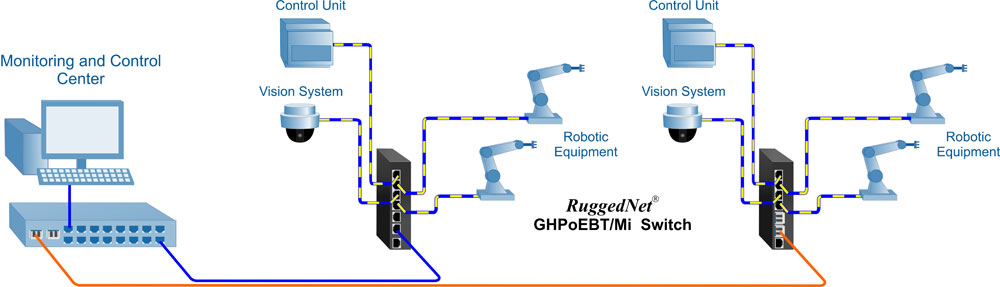
Key Solution Features
- 4 x 10/100/1000BASE-T RJ-45 PoE++ Ports (IEEE 802.3bt Type 4) providing up to 100W per port
- 1 x 10/100/1000BASE-X SFP Fiber Uplink Port and 1 x RJ-45 Copper Uplink Port for flexible connectivity
- Extended Operating Temperature Range (-40°C to +75°C) for use in harsh industrial settings
- DIN-Rail Mountable Hardened Metal Enclosure suitable for factory control panels
- Advanced Management Features including:
- PoE Watchdog (Self-Healing Function): Automatically detects and resets unresponsive PoE devices
- PoE Heartbeat Monitoring: Ensures active device responsiveness through periodic health checks
- Configurable PoE Power Reset: Allows remote, scheduled or event-driven power cycling of connected devices
- SNMP, CLI, and Web GUI Support for full network visibility and control
With RuggedNet GHPoEBT switches installed at each robotic station, the customer was able to deliver both high-speed data and 100W power over a single Ethernet cable, significantly simplifying infrastructure and reducing cabling costs. The combination of fiber and copper uplink options provided flexibility in connecting remote and nearby network zones, while rugged design ensured reliable operation around-the-clock.
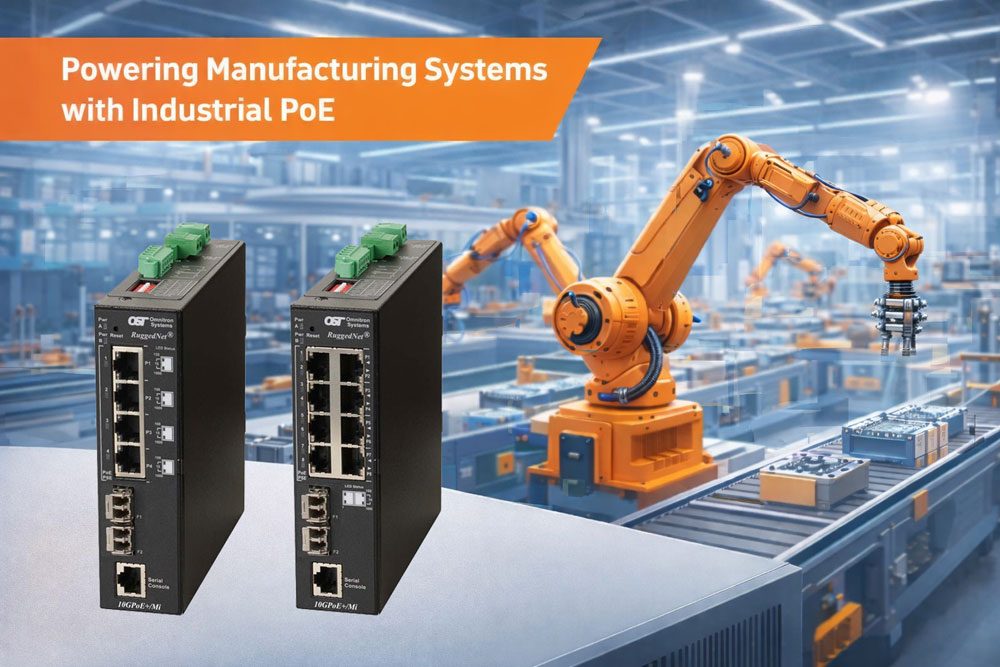
The Result and Conclusion
After full deployment of Omnitron’s RuggedNet GHPoEBT switches, the manufacturing company realized significant operational improvements:
- Simplified Cabling Infrastructure: Combined power and data over a single cable reduced installation time and complexity.
- Improved Uptime: Automated device recovery via PoE watchdog features dramatically reduced on-site maintenance and unplanned downtime.
- Enhanced Network Control: Centralized management tools provided real-time visibility and control over robotic devices.
- Operational Scalability: Flexible uplink options enabled future expansion of the robotic system without redesigning the network.
The deployment of Omnitron RuggedNet GHPoEBT switches enabled the major manufacturing company to power and connect its high-tech robotic equipment with a robust, intelligent, and highly flexible network. The solution delivered long-distance fiber connectivity, 100W PoE++ per port, and advanced device management—reducing operational downtime and simplifying network administration.
With Omnitron’s Made-in-USA rugged solutions at the core of its manufacturing network, the company is now equipped to expand its automation initiatives with confidence, performance, and efficiency.
Why Omnitron Systems
The customer selected Omnitron Systems based on the following factors:
- Reliability in Harsh Environments: RuggedNet switches are industrially hardened and certified for extreme conditions, ensuring uptime in 24/7 manufacturing operations.
- Exceptional Technical Support: Omnitron’s knowledgeable support team worked closely with the customer through deployment, configuration, and testing.
- Advanced PoE Management Capabilities: Features such as PoE Watchdog, Heartbeat Monitoring, and Configurable Reset provided intelligent device management and minimized human intervention during device failures.
- Standards-Based Compliance: Full IEEE 802.3bt, 802.1Q VLAN, and QoS support ensured seamless interoperability with existing and future systems.
- Made in the USA: Domestic manufacturing and quality assurance were critical for supply chain reliability, security standards, and ongoing support.
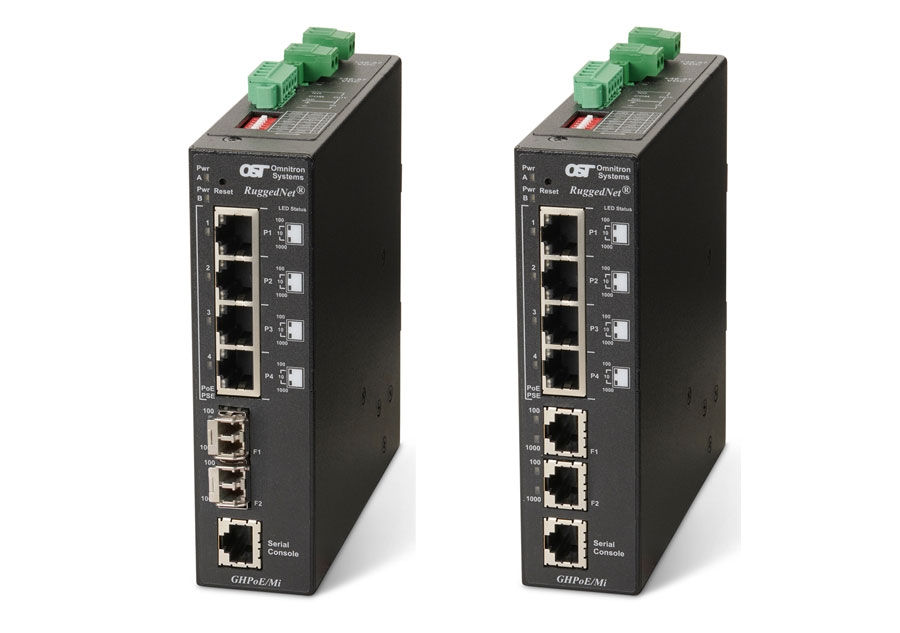
RuggedNet GHPoEBT/Mi
Managed Industrial 6-Port 60/100W IEEE 802.3bt Gigabit Switches
The RuggedNet GHPoEBT/Mi is a managed PoE, PoE+ and PoE++ Industrial Ethernet switch that features fiber or copper uplink ports and four 10/100/1000 PoE/PoE+ RJ-45 copper user ports.
The uplink ports support two 10/100/1000 copper or 100M/1G fiber uplink ports. The GPoEBT/Mi supports IEEE 802.3bt (60 and 100W) per user port depending on the model.
Part Number: 3319B-0-24-2Z
- Supports IPv4 and IPv6
- PoE Watchdog Self-Healing function / PoE Heartbeat Monitoring and Configurable PoE Power Reset
- PoE power management with LLDP MED and MDI TLV, and PoE Power Multi-Day Scheduler
- Management via Web, Telnet, SSH, SNMPv1/v2c/v3 and serial interfaces
